Description
Form:
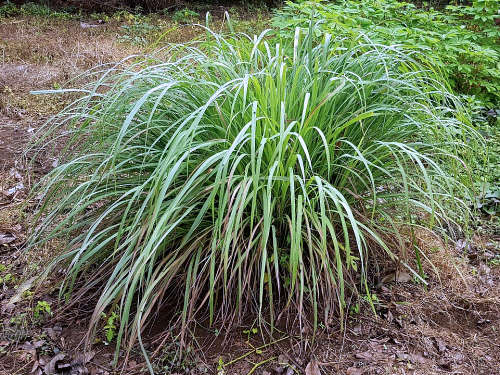
A large, dense, aromatic, clumping grass.
Lifespan:
This tropical plant is perennial in regions without freezes.
It is grown as an annual in colder climates.
Growth rate:
Rapid.
Mature Size:
3-4' (90-120cm) high and 2-3' (60-90cm) wide.
Flowers:
Small, cream, white, or green, in branching, feathery spikes from the top of mature, thick
stalks.
Bloom:
This plant only blooms in hot tropical regions with high humidity and highly organic soil.
Fruit:
Dry grass grain.
Leaves:
Long, narrow, rough margins, drooping, green to bluish-green, becoming reddish in fall
with dropping temperatures, fragrant, edible.
Stems:
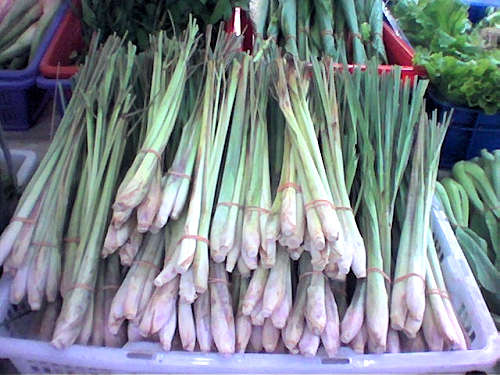
Herbaceous, light-green to white, edible.
Purplish or reddish colors signify a different species.
Depending on soil fertility, water and sun, mature stalks can be up to 1" (2.5cm) wide.
Roots:
A rhizomatous root crown produces fibrous, shallow roots.
New stalks grow from the center of the root crown.
Wildlife:
This grass rarely needs protection from browsing animals except cattle and horses.
Its tough texture and aroma usually deters most animals.
This plant species does not repel mosquitoes.
Toxic / Danger:
Lemon grass is safe for human consumption in moderate amounts but causes stomach upset in
cats, dogs, and horses.
It is safe for rabbits in modest amounts, and tortoises, although they may avoid it.
Origin:
Indonesia, Malaysia, Brunei, and the Philippines.
Cultivation and Uses
USDA hardiness zones:
9-12.
Heat tolerant:
Yes except lemon grass must have full afternoon shade in high heat.
Drought tolerant:
No.
Sun:
Full morning sun and full afternoon shade in hot desert regions.
Planting:
Plant outside after the danger of frost is past.
Locate the plant where it will get full afternoon shade, such as the east side of a house.
The soil must be well draining, but slightly moist.
Drip irrigation or daily watering in a raised garden bed is recommended with the plants
spaced 2' (60cm) apart.
A very large pot can be used but pots dry out faster.
Soil:
Well drained, slightly moist, loamy to sandy-loamy, pH 6.0-8.0 (slightly acidic to
slightly alkaline).
Lemon grass is a heavy feeder in the hottest months.
In spring and summer, fertilize monthly with a 10-6-4 NPK ratio or other high nitrogen
fertilizer.
Do not fertilize in winter when the plant is dormant.
Plants in pots need fertilizing every two weeks with a balanced liquid fertilizer.
Water after becoming established:
Keep the soil moist 2" (5cm) below the dry surface.
Daily watering in a raised garden bed or drip irrigation will be needed in hot, arid
climates.
Brown leaves are a sign of insufficient soil moisture.
Mulch:
Potted plants should be mulched to help retain moisture.
Mulch should be applied around the base of grass clumps in the ground.
Prune:
Harvest by cutting the outermost stalks at ground level when they reach 1/2" (13mm) in
width.
Do not remove more than one-third of the plant at one time.
New stalks grow from the center.
Litter:
None.
Propagation:
Stalks with root crown, root division.
Purchase lemon grass stalks from Asian grocery stores with as much of the root base as
possible.
Place the stalks in water for several days until roots appear.
Plant them outside mid to late winter when the danger of frost has passed, or mid fall.
Large mature lemon grass clumps can be carefully dug up and divided.
Uses:
Edible stalks and leaves.
Lemon grass pale-colored stalks are used to add a lemony flavor to cooking, but
are very low in vitamin C.
Wash the stalks, cut off the root base, and remove the tough outer leaves.
Cut off the leafy green tops to use later.
Finely mince the inner part of the stalks, then add them to the food to be cooked.
For soups and stews, it is easier to crush the stalks, cut them into 2" (5cm)
lengths, add them to the pot, then remove them after cooking.
The green leaves, which can be sun dried first, can be used to flavor teas, soups, and
sauces.
Comments
This plant is a member of the true Grass family (Poaceae).
Within this family, the Cymbopogon genus contains 52 species, several of which are called
Lemon Grass.
Two species have culinary use, this plant, Cymbopogon citratus, which is preferred for
cooking because it is milder and less bitter, and Cymbopogon flexuosus, native to India
through Vietnam.
The two are often confused.
C. flexuosus, called East Indian Lemon Grass, has more erect leaves with finely serrated
edges which can cause skin cuts if not handled properly, grows taller to 6.5' (2m), has
thinner, purple-reddish tinged stems, and is primarily used for producing essential oils
and perfumes or sometimes making tea.
A third species, Cymbopogon nardus, called citronella grass, is sold at nurseries and
repels mosquitos and other insects.
It has a lemon grass smell but has thin stalks and is inedible.
Look for thick stalks if you want lemon grass for cooking and not as a mosquito repellent.
Do you have additional information or a different experience for this plant that you would
like to share? Email info@GardenOracle.com. All contributions are welcome and appreciated.