

Growing Aristolochia watsonii:
Southwestern Pipevine

Description
Form: A rambling vine.
Lifespan: Perennial.
Leaf retention: Evergreen in frost-free regions.
Growth rate: Slow.
Mature Size: Vines 1-3' (30-100cm) long form a dense, tangled, green or purple-tinged brown mat, of stems and leaves, typically 1-2' (30-60cm) wide and 1" (2.5cm) high.
Flowers: Tiny, mouse-ear-shaped, green and brown-speckled flowers. Each flower lasts one or two days. The flowers give off an aroma similar to that of a rodent's ear. This attracts blood-sucking midges, which normally feed on the inside of rodent ears. The flower traps them overnight, when pollen is released, then lets them go the next morning, forcing them to become pollinators.
Bloom: Spring and summer.
Fruit: A capsule with five vertical ribs containing stacks of flat, black, triangular seeds in five compartments.
Leaves: Small, green, usually slender, arrowhead shaped leaves, 1-1.5" (2.5-3.8cm) long, which turn purple-brown in full sun and drought conditions.
Stems: Prostrate, branching.
Roots: Horizontal underground stems (rhizomes) have nodes with roots along their length which can produce new vertical shoots. Some rhizomes thicken to act as storage for nutrients and energy, allowing survival in adverse conditions like extended drought or leaf destruction by caterpillars.
Wildlife: The Pipevine Swallowtail lays its eggs on this plant. Its caterpillar, eating the leaves, incorporates the plant's poison into its skin to ward off predators. The caterpillar can completely defoliate the plant, but the leaves will grow back. Tiny flies, called biting midges, pollinate the flowers. Lizards may search the plant looking for butterfly eggs and caterpillars.
Toxic / Danger: All parts of this plant are toxic.
Origin: Native to Arizona, New Mexico and Mexico.
Form: A rambling vine.
Lifespan: Perennial.
Leaf retention: Evergreen in frost-free regions.
Growth rate: Slow.
Mature Size: Vines 1-3' (30-100cm) long form a dense, tangled, green or purple-tinged brown mat, of stems and leaves, typically 1-2' (30-60cm) wide and 1" (2.5cm) high.
Flowers: Tiny, mouse-ear-shaped, green and brown-speckled flowers. Each flower lasts one or two days. The flowers give off an aroma similar to that of a rodent's ear. This attracts blood-sucking midges, which normally feed on the inside of rodent ears. The flower traps them overnight, when pollen is released, then lets them go the next morning, forcing them to become pollinators.
Bloom: Spring and summer.
Fruit: A capsule with five vertical ribs containing stacks of flat, black, triangular seeds in five compartments.
Leaves: Small, green, usually slender, arrowhead shaped leaves, 1-1.5" (2.5-3.8cm) long, which turn purple-brown in full sun and drought conditions.
Stems: Prostrate, branching.
Roots: Horizontal underground stems (rhizomes) have nodes with roots along their length which can produce new vertical shoots. Some rhizomes thicken to act as storage for nutrients and energy, allowing survival in adverse conditions like extended drought or leaf destruction by caterpillars.
Wildlife: The Pipevine Swallowtail lays its eggs on this plant. Its caterpillar, eating the leaves, incorporates the plant's poison into its skin to ward off predators. The caterpillar can completely defoliate the plant, but the leaves will grow back. Tiny flies, called biting midges, pollinate the flowers. Lizards may search the plant looking for butterfly eggs and caterpillars.
Toxic / Danger: All parts of this plant are toxic.
Origin: Native to Arizona, New Mexico and Mexico.
Cultivation and Uses
USDA hardiness zones: 8-9, possibly greater. The stems and leaves die in freezes.
Heat tolerant: Yes.
Drought tolerant: Yes.
Sun: Best in part shade, but tolerates full sun.
Soil: Well draining, dry, low organic content, pH 6.6-7.5 (neutral).
Water once established: Once every month or two. Supplemental water may improve growth. The soil should dry out between waterings.
Prune: Brush away dead leaves and stems after the last freeze is past.
Litter: Low.
Propagation: Seed.
Uses: To attract and propagate the Pipevine Swallowtail butterfly.
USDA hardiness zones: 8-9, possibly greater. The stems and leaves die in freezes.
Heat tolerant: Yes.
Drought tolerant: Yes.
Sun: Best in part shade, but tolerates full sun.
Soil: Well draining, dry, low organic content, pH 6.6-7.5 (neutral).
Water once established: Once every month or two. Supplemental water may improve growth. The soil should dry out between waterings.
Prune: Brush away dead leaves and stems after the last freeze is past.
Litter: Low.
Propagation: Seed.
Uses: To attract and propagate the Pipevine Swallowtail butterfly.
Comments
This plant is a member of the Birthwort family (Aristolochiaceae). Other common names are Watson's Dutchman Pipe, and Mouse Ears. It is also called Indian Root and Snakeroot because Native Americans used it as a remedy for snake bites.
It is difficult to spot on open ground because of its small size. Follow a Pipevine Swallowtail butterfly to locate the plant.
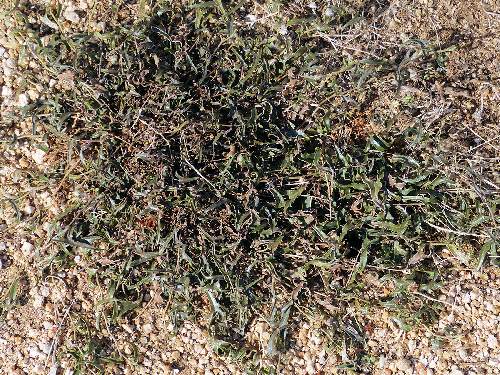
The third picture from the top is an Aristolochia watsonii mat, 12x16" (30x40cm), on an east-facing slope. The slope attenuates the afternoon sun and allows the mat to stay green.
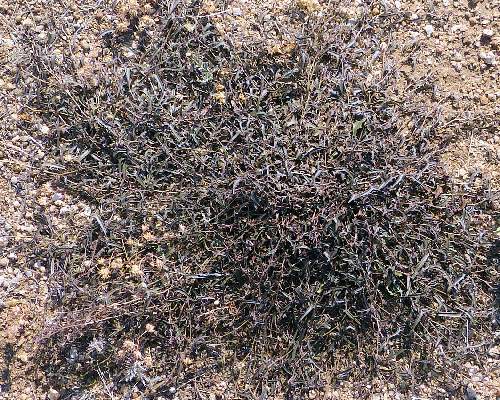
The bottom picture is a healthy, 2' (60cm) wide, Aristolochia watsonii mat in full sun and drought conditions on level ground. The root system is at least 8 years old. This plant, and the plant in the picture above, are 50' (15m) apart, sharing the same temperature and rainfall conditions.
These plants have become large because nearby lizards routinely search them for butterfly eggs and small caterpillars. The caterpillars are never allowed to get large enough to eat the whole plant and slow its root growth.
All photos were taken in USDA hardiness zone 8b.
Do you have additional information or a different experience for these plants that you would like to share? Email info@GardenOracle.com. All contributions are welcome and appreciated.
This plant is a member of the Birthwort family (Aristolochiaceae). Other common names are Watson's Dutchman Pipe, and Mouse Ears. It is also called Indian Root and Snakeroot because Native Americans used it as a remedy for snake bites.
It is difficult to spot on open ground because of its small size. Follow a Pipevine Swallowtail butterfly to locate the plant.
The third picture from the top is an Aristolochia watsonii mat, 12x16" (30x40cm), on an east-facing slope. The slope attenuates the afternoon sun and allows the mat to stay green.
The bottom picture is a healthy, 2' (60cm) wide, Aristolochia watsonii mat in full sun and drought conditions on level ground. The root system is at least 8 years old. This plant, and the plant in the picture above, are 50' (15m) apart, sharing the same temperature and rainfall conditions.
These plants have become large because nearby lizards routinely search them for butterfly eggs and small caterpillars. The caterpillars are never allowed to get large enough to eat the whole plant and slow its root growth.
All photos were taken in USDA hardiness zone 8b.
Do you have additional information or a different experience for these plants that you would like to share? Email info@GardenOracle.com. All contributions are welcome and appreciated.
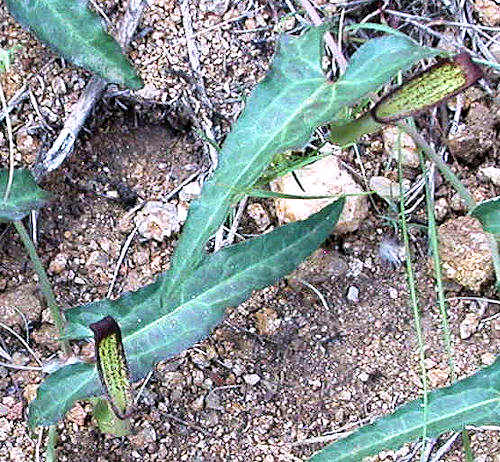
The odd-shaped flowers have brown speckles.
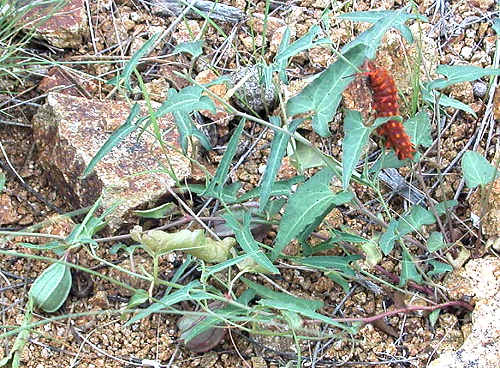
Two seed capsules can be seen at lower left and lower center.
A third one is near the center.
The caterpillar will develop into the Pipevine Swallowtail butterfly.
The caterpillar will develop into the Pipevine Swallowtail butterfly.
Latest update: August, 2026
© 2008-2026 by GardenOracle.com